
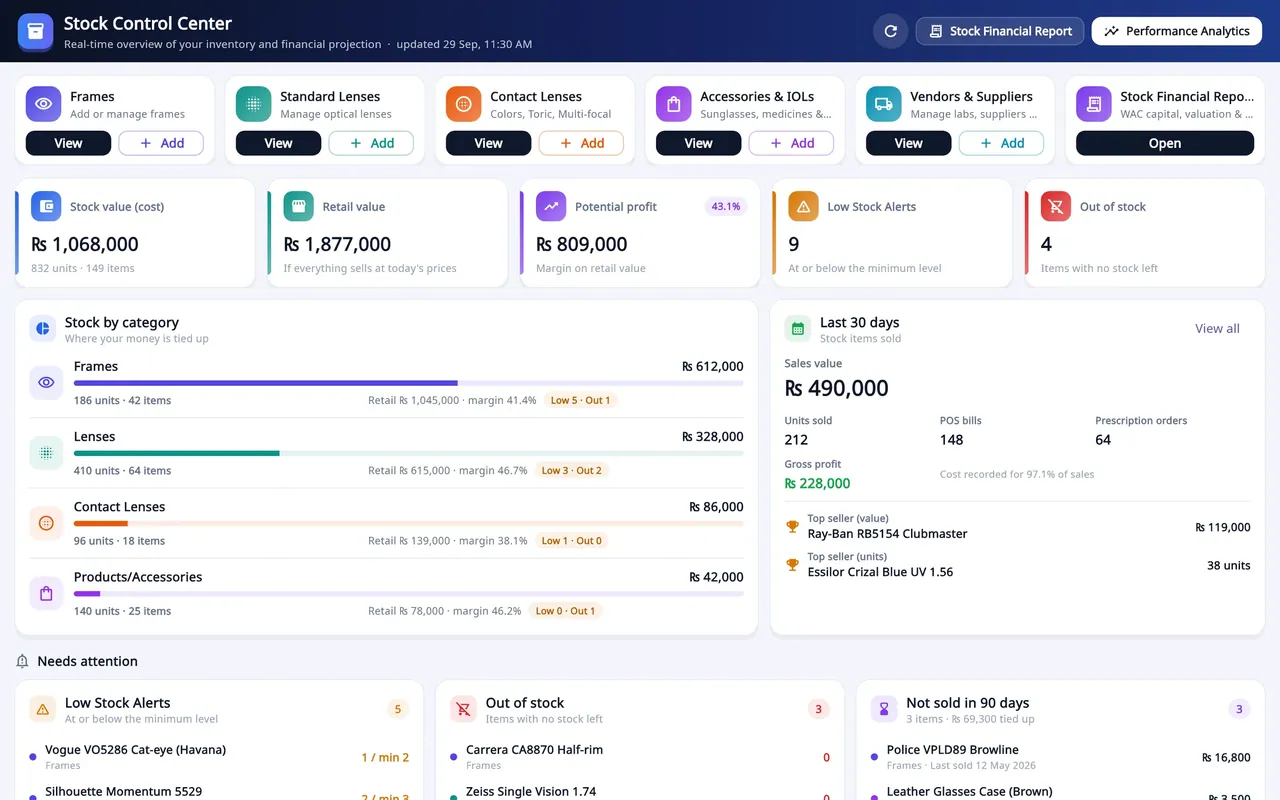
Optical shop management SaaS
Asaan Optics
Optical shop software for Android and Windows: prescriptions, counter sales, stock and staff shifts on one shared shop account.
- SaaS product
- Mobile app
- Desktop app
- Business system
Most problems in business software come from decisions made before the first screen: how data is modeled, where rules are enforced, how clients sync and who is allowed to do what. I help teams make those decisions deliberately, either as part of building the product or as a separate design and review piece of work.
More than once I have designed one backend shared by several client apps. Asaan Optics runs Android and Windows apps on one multi-tenant API, and KAYANAK runs a public website, an admin CRM, partner portals and a Flutter app on one NestJS API. I have also audited existing codebases, including a multi-tenant education platform and an expat utility app that I then rebuilt module by module.
Modules, entities, relationships and boundaries, written down before the build so everyone builds the same system.
Tenant isolation, organizations and branches, roles and permission matrices.
Versioned REST contracts with OpenAPI documentation, shared by the web, mobile and desktop clients.
Idempotency keys, durable queues, dead-letter handling and server-issued serial numbers for apps that write while offline.
Authentication, sessions, privilege checks and secrets handling reviewed and fixed, with findings ranked by risk.
A written assessment of an existing product: what works, what is missing, what is risky, and the order to fix it in.
Payments, messaging, AI services and e-invoicing placed behind clear interfaces, so a provider can change without a rewrite.
I start from the business action, not the table. A sale, a booking or a lease touches several records, so I map what must change together and wrap it in a transaction. It is the point I make when I write about ERP software: creating records is easy, and keeping every connected record consistent is the real work.
KAYANAK runs on a NestJS modular monolith with Prisma and PostgreSQL, which I built as lead developer: one deployable service with clear modules, shared core services and in-process events, so commissions, the CRM and notifications react to the same business events without being tied to each other. For Just Book, a home-services marketplace still in development, the Laravel backend owns pricing, a booking state machine and availability slots that prevent double-booking, so the app never decides those on its own.
When I review an existing system, I write it up first. On Arab Expat I began with an audit of 61 findings, then rebuilt the product module by module against written architecture contracts. On CampusPro, a multi-tenant .NET and React platform built by another developer, I wrote an audit and then a security patch, with the project's first integration tests, to close privilege-escalation paths. I describe findings plainly and fix the riskiest ones first.
The business actions, the people involved, the data they depend on and the constraints, such as offline use or tax rules.
Entities, relationships, modules and the transactions that must succeed or fail together.
Architecture, API contract, security model and hosting, written down and reviewed with your team.
Sync, payments or integrations that could sink the project are built and tested first.
I build the system, or support your developers while they build against the design.
Optical shop management SaaS
Optical shop software for Android and Windows: prescriptions, counter sales, stock and staff shifts on one shared shop account.
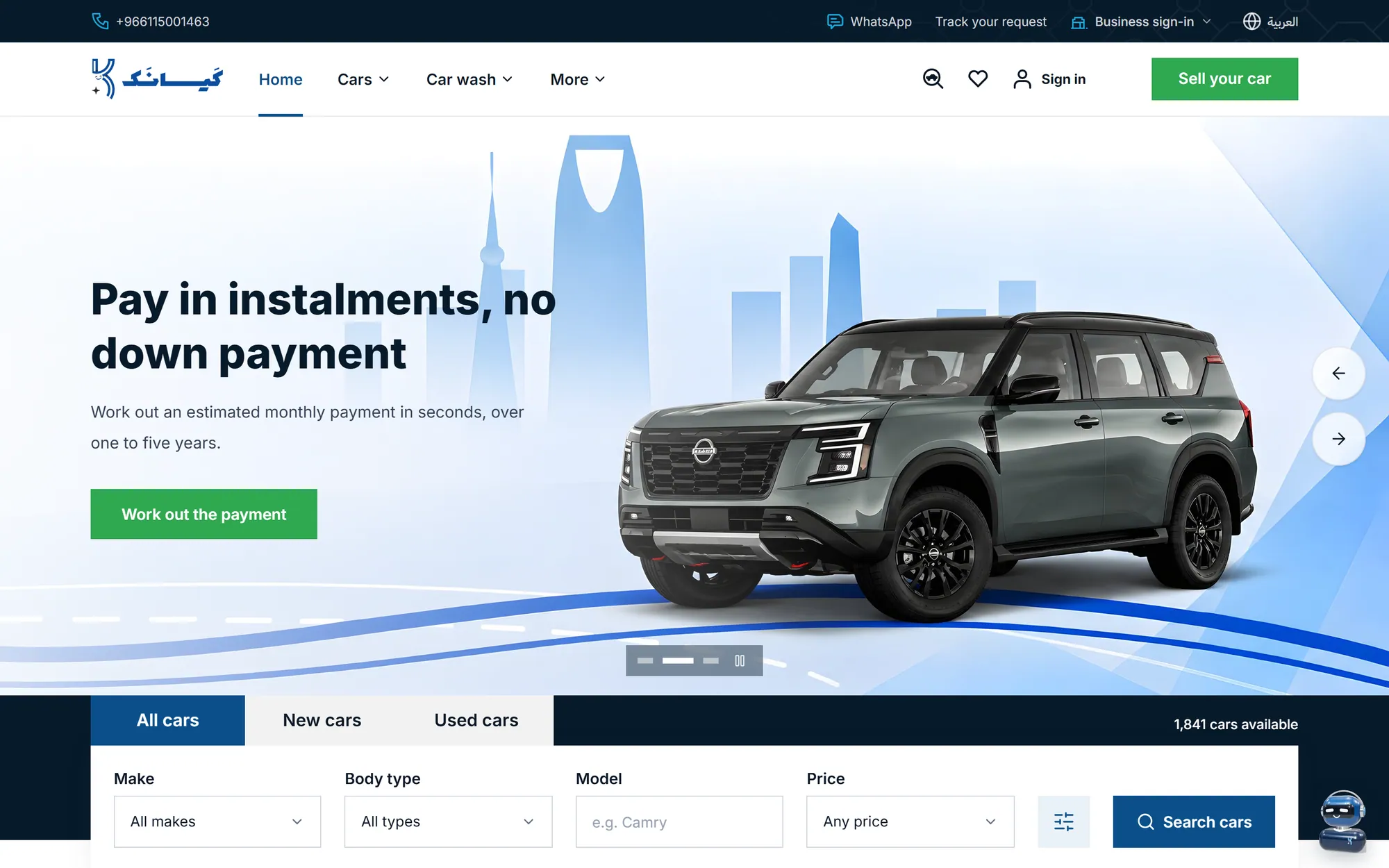
Car marketplace and sales CRM
Arabic-first car marketplace and sales CRM for a Riyadh car business, with installment pricing, car-wash booking and an AI sales assistant.
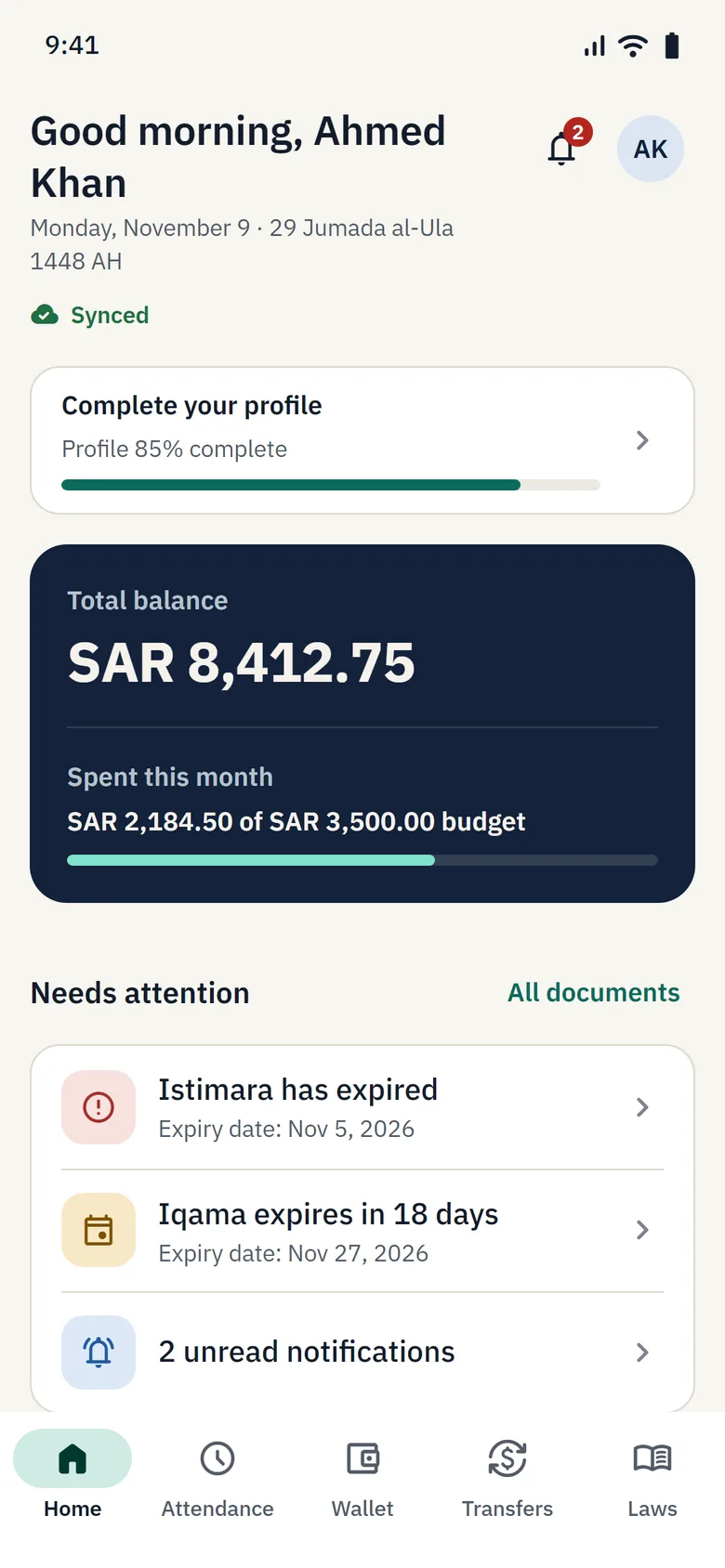
Personal utility app for expats
An offline-first Android app that helps expats in Saudi Arabia track documents, overtime, spending, remittances and their labor rights.
Farhad Nazir is a full-stack software developer based in Riyadh, Saudi Arabia. He builds web applications, SaaS platforms, Flutter mobile apps and Windows desktop software, and is the founder and developer of Asaan Optics, published by his company Techwine Solutions. He holds a bachelor's degree in software engineering from COMSATS University Islamabad and has worked at GOFTECH, Exytex Technologies and Cognitojs.
Yes. I produce a written audit covering architecture, security, the data model, missing features and deployment, with findings ranked by risk and a plan to fix them. I did this for Arab Expat and CampusPro before changing any code.
Both. Most of my architecture work is on products I then build, such as Asaan Optics and KAYANAK. I can also produce a design for your own team to implement and review their work against it.
For most business products I start with a modular monolith: one deployable service with clear internal modules. It is simpler to run and change, and modules can be split out later if load or team size calls for it. KAYANAK runs this way on a single NestJS API.
Every write from the client carries an idempotency key, writes that cannot be sent wait in a durable queue, and the server replays its first answer instead of recording a repeat. Failed items go to a dead-letter list instead of disappearing, and numbers such as invoice serials are issued by the server so phones and PCs never collide.
Yes. I am based in Riyadh and have delivered work for businesses in Saudi Arabia and Pakistan, and Asaan Optics is set up for shops in Pakistan, Saudi Arabia and India. I work through calls, shared documents and regular builds you can test.
Tell me what you are trying to fix. I will reply with honest questions, a practical plan and a realistic estimate.