
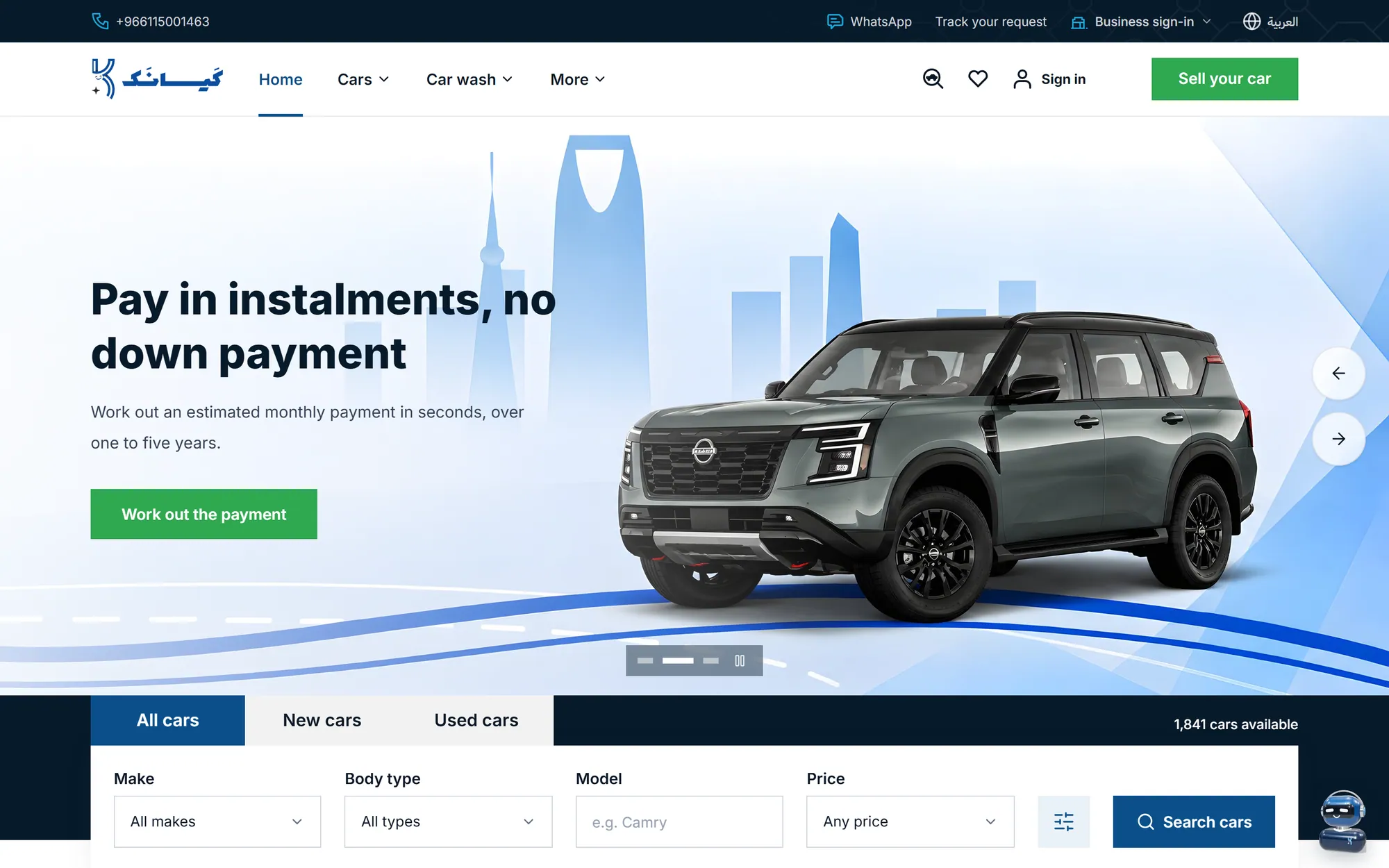
Car marketplace and sales CRM
KAYANAK
Arabic-first car marketplace and sales CRM for a Riyadh car business, with installment pricing, car-wash booking and an AI sales assistant.
- Web application
- Mobile app
- E-commerce
- Business system
I build web applications that run real parts of a business: online stores with their own back office, sales CRMs, ERPs, booking platforms and the APIs behind mobile apps. Most of my web work is in Laravel with Livewire, or in Next.js and React on top of a Node.js API, with MySQL or PostgreSQL underneath.
Projects I have shipped include KAYANAK, an Arabic-first car marketplace and sales CRM for a Riyadh car business where I was the lead developer in a small team, the Designers Glasses and Faisal Optical Service eyewear stores with step-by-step prescription lens configurators, and SoftHouse Pro, an ERP for a software house. Each one has a custom admin panel, so the people running the business can manage it without a developer.
CRMs, ERPs, portals and internal tools built around your actual workflow, with roles and permissions for each type of user.
Back offices for catalogs, orders, customers, content and settings, with dashboards and Excel exports where the business needs them.
Versioned APIs that serve web, mobile and desktop clients from one set of business rules, documented so other developers can work against them.
Bilingual sites with right-to-left layouts and the language in the URL, as on the KAYANAK website.
Payment gateways, WhatsApp messaging, SMS sign-in, push notifications, email and file storage, connected on the server where they can be checked and logged.
Setup on shared hosting, a VPS or a cloud platform, including domains, SSL, environment configuration and the web server.
I start with the data model and the roles. Before building screens I want to know who uses the system, what they enter and what must stay consistent when it changes. On SoftHouse Pro that meant four separate portals (executive, manager, employee and client) over one database, with multi-table writes wrapped in transactions so attendance, tasks and invoices stay in step.
I choose the stack to fit the job. For stores and business systems that need a strong admin panel, I use Laravel with Livewire and Alpine.js, which keeps everything in one maintainable codebase. When one API has to serve a public website, an admin dashboard, partner portals and a mobile app, as on KAYANAK, I build a TypeScript backend with NestJS and Prisma, with Next.js on the front end.
Money, identity and anything a user could tamper with is decided on the server. On Estasher I moved sign-in, payment verification, VAT and commissions into a new server API, so the app can no longer mark its own orders as paid. On the eyewear stores, lens prices come from a pricing engine the store manages in its admin panel, not from the browser.
We go through how the work is done today, who will use the system and what the first release must include.
I define the entities, roles, integrations and hosting, so the build rests on decisions that are written down.
For larger systems I build clickable prototypes first. SoftHouse Pro started as static HTML screens before any Laravel code.
Features arrive in usable pieces on a staging site, so feedback shapes the next piece instead of the final delivery.
Deployment, data import, admin training and a check of payments, email and other integrations in production.
Fixes, updates and new features after launch, based on how the system is actually used.
Car marketplace and sales CRM
Arabic-first car marketplace and sales CRM for a Riyadh car business, with installment pricing, car-wash booking and an AI sales assistant.
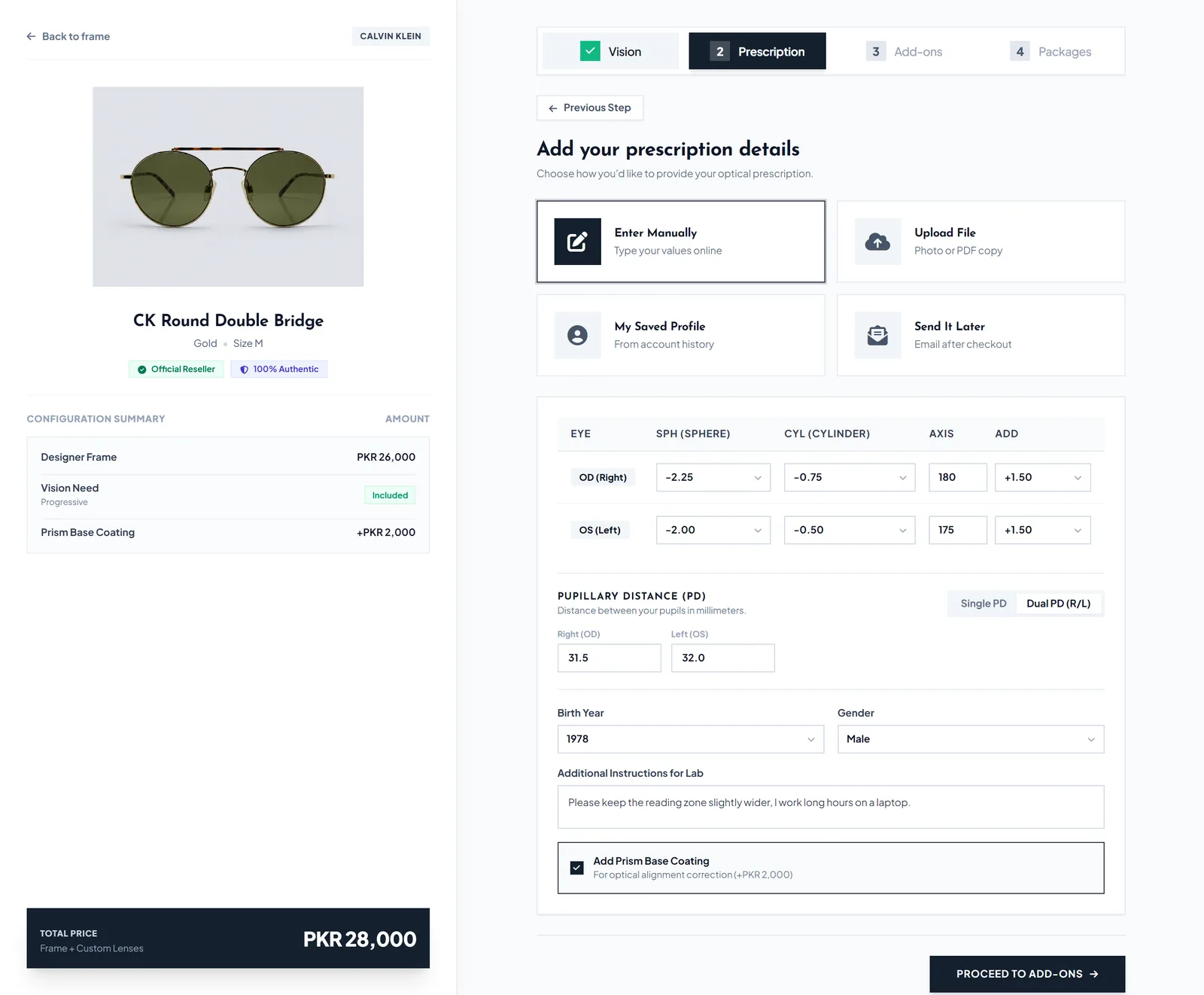
Eyewear e-commerce and store ERP
An online eyewear store with a step-by-step prescription lens configurator, contact lens shop and a full admin back office.
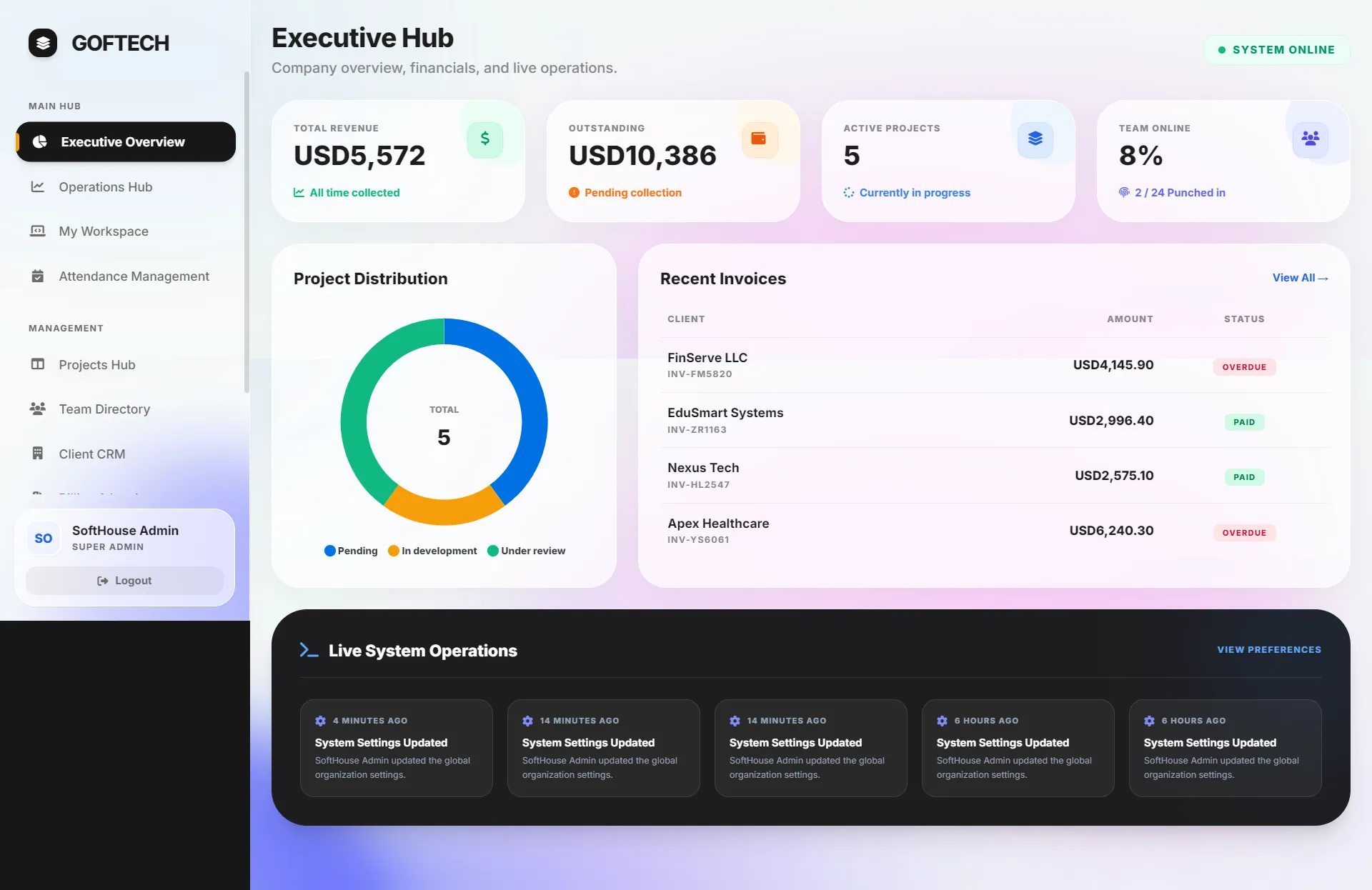
ERP for software houses and agencies
A Laravel ERP that gives software houses one place for projects, attendance, performance scoring, invoicing and a client portal.
Yes. Farhad Nazir is a full-stack software developer based in Riyadh, Saudi Arabia, and works with businesses in Riyadh, elsewhere in Saudi Arabia and abroad. His Saudi work includes KAYANAK, a car marketplace and sales CRM for a Riyadh car business, and Estasher, an engineering consultation app on the App Store and Google Play.
For the web, Farhad mainly uses Laravel and PHP with Livewire, and Next.js, React and Node.js with TypeScript. For mobile and Windows desktop apps he uses Flutter and Dart. Data usually lives in MySQL, PostgreSQL or SQLite, with Firebase where an app needs push notifications or authentication.
Yes. KAYANAK is Arabic-first, with right-to-left layouts and separate Arabic and English URLs, and the HappyHome Stays prototype supports full English and Arabic with right-to-left layouts. I plan for both directions from the start rather than flipping the layout at the end.
It depends on the project. Laravel with Livewire suits stores, ERPs and admin-heavy systems that benefit from one codebase. A Next.js front end on a separate API suits platforms where the same backend also serves mobile apps and partner portals. I explain the trade-off before we start.
Ownership is agreed in writing before work starts. I set projects up so the client holds the domains, hosting and service accounts the system runs on. On Estasher, for example, the server, app store accounts and services all run under the client's own accounts.
It depends on the scope, the integrations and how quickly decisions are made. I give an estimate after scoping, then build in working increments so you can use real software early rather than waiting for one final delivery.
Tell me what you are trying to fix. I will reply with honest questions, a practical plan and a realistic estimate.